BeeWise business guide
Referral programs for small businesses in Botswana
Decide if referrals fit your shop or food business in the Botswana market. Check commission margins, shop and WhatsApp sales records, refunds and approval responsibility.
Published · BeeWise Digital Marketing Agency
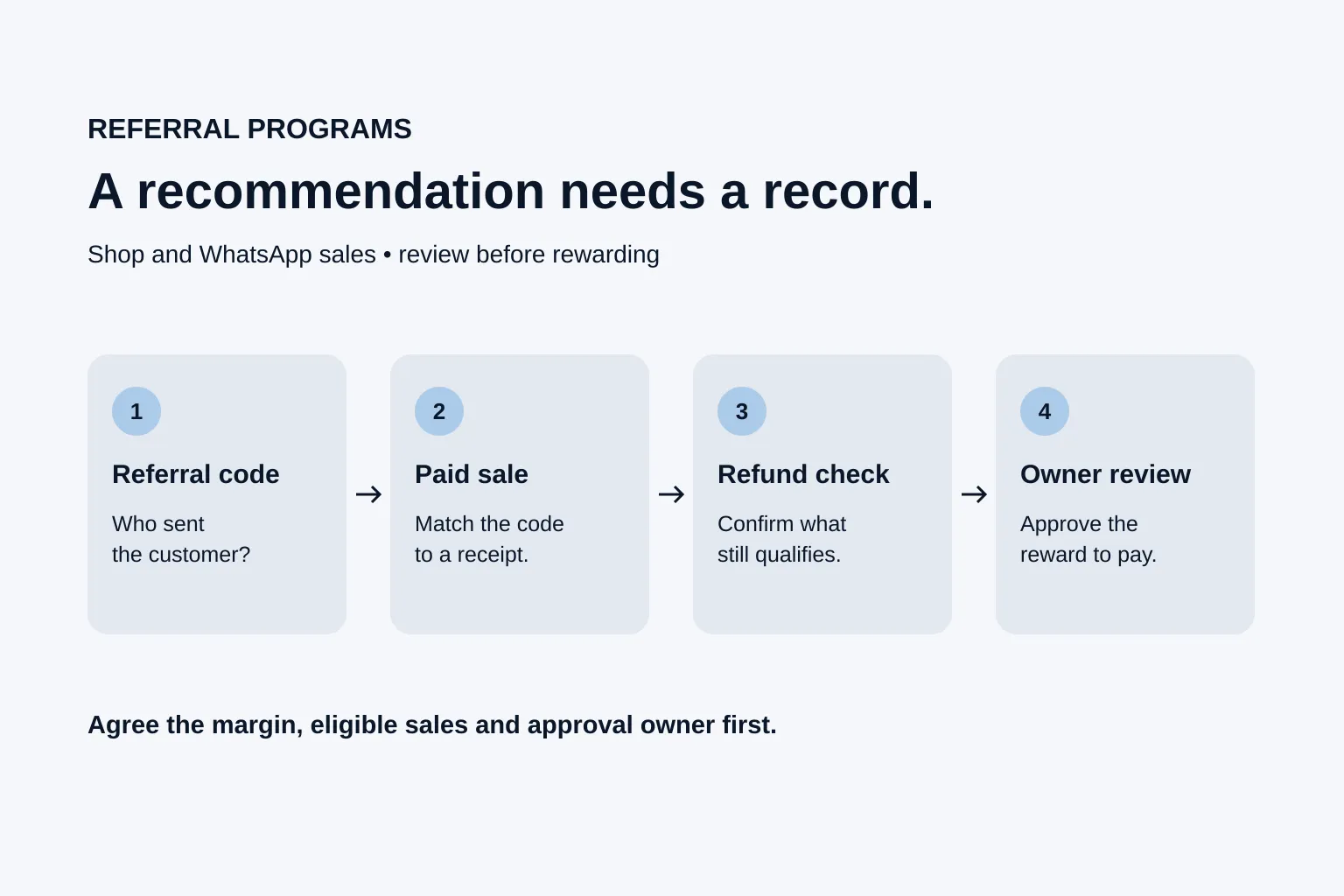
A referral program for small business works best when happy customers already recommend you, each referred sale leaves room for a reward, and someone can verify the sale before approving it. For a shop or food business in Botswana, that means checking margins, recording shop and WhatsApp orders, and agreeing what happens after a refund. Start with a small group and written rules before opening the program widely.
What is the difference between referral and affiliate programs?
A customer referral program rewards existing customers for introducing new customers. An affiliate program pays approved partners an agreed commission for eligible sales they help generate, usually recorded through a link or code.
The distinction is mainly who recommends you and how they participate. A regular customer sharing your takeaway menu with a friend is a referral candidate. A food creator or neighbouring business regularly promoting your offer may be an affiliate candidate. Both need clear sales records and reward rules.
| Approach | Who takes part | When it fits |
|---|---|---|
| Customer referrals | Customers who know your business | You have satisfied repeat customers who can introduce friends |
| Affiliates | Approved partners who can reach relevant buyers | You can support ongoing partner relationships and review commission claims |
Decide whether the reward is cash, store credit or another benefit. Explain its value and conditions before anyone shares your offer.
Does a referral program fit your small business?
Use these five checks before paying for setup:
- Margin: Can eligible sales cover the reward, discounts and administration while still contributing to rent, salaries and profit?
- People: Can you name customers or partners who know your offer and might willingly recommend it?
- Records: Can staff connect a referral code to a paid receipt or order, including sales agreed on WhatsApp?
- Refunds: Can you identify cancellations, returns and partial refunds before rewards are approved?
- Responsibility: Have you named the person who reviews sales and the person who authorizes payments?
Proceed with a small pilot if you can answer all five. If margin is tight, restrict the program to suitable products or orders. If records or responsibility are unclear, fix those first. If you have few satisfied customers yet, focus on delivering a good experience and learning why customers return before adding rewards.
Calculate what remains after the commission
Use the amount retained from a sale after discounts and applicable tax, then subtract the costs that rise with that order: stock or ingredients, packaging, payment charges and any delivery subsidy. The balance is the order's contribution before referral rewards. It still has to help pay your fixed costs.
Here is a hypothetical takeaway-order example in Botswana pula, not a recommended commission rate:
| Item | Amount |
|---|---|
| Sale amount retained after discounts and any applicable tax | P200 |
| Ingredients, packaging and other order-related costs | −P130 |
| Contribution before referral commission | P70 |
| Commission: 10% of the agreed P200 eligible amount | −P20 |
| Contribution after commission, before fixed costs and program fees | P50 |
If your target contribution is P50, that P20 reward uses the whole available allowance. Adding a P10 welcome discount would reduce contribution to P40 if the other figures stayed the same. Check both sides of a reward offer, not just the partner's commission.
A useful planning formula is:
Maximum reward allowance = contribution before rewards − contribution you need to retain.
Then budget separately for setup, ongoing program fees and staff review time. Test the calculation on your lower-margin products as well as an average order. Avoid funding rewards on today's sale solely because you hope the customer will buy again.
Start with people who already know the business
Write down a short list of satisfied regular customers and relevant partners. For a shop, these might be customers who already recommend particular products. For a food business, they might be regular buyers or nearby businesses whose customers need your food offer.
Invite a manageable group personally. Explain what they can share, what counts as an eligible sale and when a reward becomes payable. Give each participant a distinct code so staff can identify the referrer without guessing.
Before launch, choose whether rewards apply only to a new customer's first order or to repeat orders too. Repeat commissions create continuing costs; include them in your margin calculation. Ask partners to make the reward relationship clear when recommending you and to avoid exaggerated claims or unsolicited group spam.
How do you record shop and WhatsApp referral sales?
Capture the referral code when the customer orders, then attach it to the final receipt or order number. A link click or a WhatsApp message alone does not prove a paid sale. The review record needs the sale, payment status and any later refund.
A basic workflow is:
- Ask before completing the sale: “Did someone recommend us? Please share their referral code.”
- Record the order: Save the code, receipt or order number, sale date, eligible amount and payment status in one agreed register.
- Match WhatsApp orders: Carry the code from the conversation into the order record. Match collection or delivery payment to that same order number.
- Review exceptions: Check duplicate claims, missing codes, unpaid orders and refunds before calculating the reward.
- Approve and record payment: Save who approved the commission, when it was approved and the payment reference after it is paid.
A simple record can use these columns:
| Field | What staff enter |
|---|---|
| Order / receipt ID | The unique sale reference |
| Referral code | The approved participant's code |
| Eligible amount and payment status | What qualifies and whether payment was received |
| Refund / cancellation | Amount, date and affected items, if any |
| Commission and status | Calculated amount; pending, approved, rejected or paid |
| Reviewer / payment reference | Named approver, approval date and payment record |
Keep customer details to what the process needs and restrict access to staff who handle review. Share a participant's own referral statement rather than the full customer register.
Agree refunds and approval responsibility before launch
Write the rules in language staff and participants can apply consistently:
- Which products and sales qualify, and whether discounted purchases qualify.
- What amount the commission percentage applies to, including treatment of discounts, tax and delivery fees.
- Which code wins when two people claim the same order, and how late or missing-code claims are handled.
- Whether self-referrals qualify.
- When a completed, paid sale becomes eligible for approval, taking account of your returns process.
- How a full refund cancels a pending reward and how a partial refund changes the eligible amount.
- How an already-paid commission is handled if the customer later receives a refund.
- The review schedule, payment schedule and route for questioning a decision.
Name actual people, not just departments. For example, put your cashier's name against code capture, your manager's name against refund and commission review, and your owner's name against payout authorization. One person may fill several roles, but each responsibility still needs an owner.
Software can help maintain records; your business still needs someone to invite partners, settle disputed claims and oversee payments.
Run a small pilot and review the remaining contribution
Choose one offer, a small participant group and a defined review period, such as 30 days. Treat that period as a planning choice, not a promise of results.
Check that staff can record a test shop order, a WhatsApp order and a refund before inviting participants. At the end of the pilot, review paid eligible orders, rewards, refunds, missing codes and staff time. Calculate contribution after rewards and program costs, and ask new buyers how they heard about you: a referral code records a claim, but does not by itself prove the sale would not have happened otherwise.
Continue if the economics and administration work. Adjust the eligible offer or reward if they don't; expand the participant group only when the team can handle the review.
Bring your offer and sales process to BeeWise
BeeWise Affiliates — referral and affiliate programs is BeeWise Digital Marketing Agency's service for setting up a branded program with links or codes, agreed commission rules and a sales-recording workflow. Your business owns partner relationships, commission approvals and payout oversight; scope and price are agreed in your proposal.
Discuss your referral program. Include what you sell, the margin available for rewards, how you record shop or WhatsApp sales, and who will approve commissions. You can also email beewise-brainer@brainer.one.